
Pie Crust Techniques: Mixing, Rolling, Lattice and Crimping
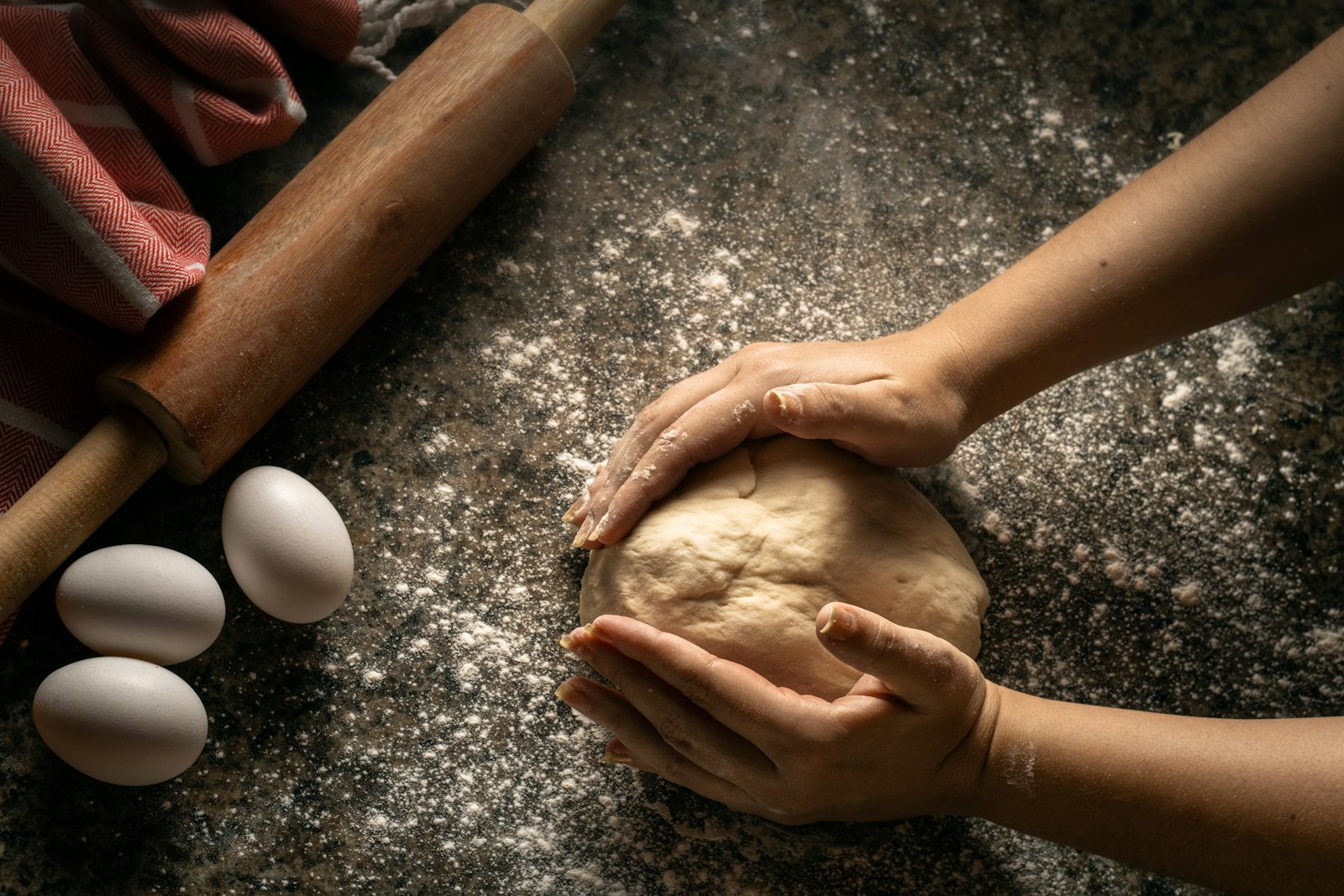
A good crust comes down to cold butter, a light hand and some practice. These techniques walk through every stage, from mixing the dough to crimping the edge, and work with any all-butter crust recipe.
Mixing the Dough
Set everything up before you start: mix your ice water, cube the butter and put it back in the fridge, and measure out the flour, sugar and salt. A wide, flat-bottomed bowl stays steady while you work, and a sturdy pastry blender makes the job much easier.
- Toss the flour, sugar and salt together in the bowl. Add the cold butter and chop it into the flour with a bench scraper.
- Switch to the pastry blender and keep cutting until the mixture looks like coarse cornmeal with a few small bits of butter still visible.
- Add half the ice water and fold it in with the pastry blender. The dough will still look dry and only just starting to clump.
- Add the rest of the water and gather the dough with your hands. Pull your fingers through it once or twice to streak the butter through the flour, then stop. Don't knead it. You're looking for streaks of butter, not large lumps.
- Wrap the dough and refrigerate it for at least 30 minutes before rolling. Wrapped well, it can be frozen for about a month.
Rolling It Out
- Take the dough out of the fridge 5 to 10 minutes before rolling. If it's too cold, it will crack.
- Lightly flour the counter and the rolling pin. Set the dough in the center and, starting a little below the middle, roll away from you in one smooth stroke, easing up as you reach the edge. With a tapered French pin, press slightly harder on the left side.
- After each stroke, turn the dough an eighth to a quarter turn counterclockwise and roll again. Dust above and below with only as much flour as it takes to keep it from sticking.
- Once the round is 8 to 9 inches across, a straight pin is gentler on the center than a tapered one. Keep rolling outward from just below the middle with even pressure, turning as you go.
- If it cracks, cut a scrap from the edge and press it over the crack, with a dab of water if needed.
- Stop when the dough is about ⅛ inch thick and 2 to 3 inches wider than your pan.
To work ahead, lay the rolled round on a larger sheet of parchment, roll the two up together loosely and freeze until solid, then wrap tightly. Let it thaw about 15 minutes, until it bends easily, before using.
Fitting a Pie Pan
Fold the round in half and lay it over one side of a well-buttered pie pan with the fold across the center. Open it up and let the dough settle into the pan without pulling or stretching it. Press out any gaps against the pan and pop any air bubbles with a fork. Trim the overhang to 1 to 1½ inches past the inner rim. Cover and chill for at least 30 minutes, ideally an hour or more. Wrapped tightly, the lined pan keeps for up to 3 days in the fridge or a month in the freezer.
Fitting a Tart or Springform Pan
- Set the pan on the rolled dough and cut around it with a pastry wheel, leaving 1½ inches extra for a springform or 2 inches for a tart pan.
- Butter the pan well and separate the base from the ring, leaving a springform latch open. Fold the dough in half, lay it over the base and unfold it so it's centered.
- Slide the ring onto one forearm and balance the lined base on that hand's fingertips. With your other hand, bring the ring up around the base as you lower the base into it. Set the pan down and close the latch if it has one.
- Ease the dough into the corners and up the sides without stretching it. In a springform, the sides only need to be about 1½ inches high.
- In a tart pan, fold the overhang inward to double the thickness of the sides and press to seal. Press down and outward with your thumb against the top edge of the pan to pinch off the excess.
- If you'll be prebaking the shell, prick the bottom and sides about 15 times with a fork so steam can escape and the crust doesn't shrink. Cover and chill as for a pie pan.
Cutting and Weaving a Lattice
Well-chilled dough is far easier to handle, and a pizza cutter gives the neatest strips. These steps make an 8-strip lattice.
- Roll the dough into a round about 12 inches across and ⅛ inch thick.
- Cut 1 inch off two opposite sides to square it up, then cut the rest into 8 strips of equal width. Move them to a floured or parchment-lined baking sheet and chill for at least 30 minutes.
- Lay strip 1 vertically over the filled pie, just left of center. Lay strip 2 horizontally across it, just below center. Lay strip 3 vertically over strip 2, to the right of strip 1, and strip 4 vertically over strip 2, to the left of strip 1.
- Fold back the right end of strip 2. Lay strip 5 vertically to the right of strip 3, then fold strip 2 back down over it.
- Fold back the top ends of strips 1 and 5, lay strip 6 horizontally above strip 2, and fold them back down. Fold back the bottom ends of strips 1 and 5, lay strip 7 horizontally below strip 2, and fold them back down.
- Fold back the top ends of strips 3 and 4, lay strip 8 horizontally above strip 6, and fold them back down. The pie is ready to crimp.
Crimping a Single-Crust Pie
For a single crust, such as a custard pie, roll the overhang under so it sits right on top of the pan's rim. Pinch firmly as you work your way around to build a sturdy wall of dough, since a loose edge can unroll in the oven. Flour your fingers if they stick. To flute, make a C shape with the thumb and index finger of one hand against the outside of the wall, and push the thumb of your other hand into it from the inside. Repeat all the way around, keeping the edge on the rim. For a simpler finish, press the edge flat onto the rim with the tines of a fork.
Filling and Crimping a Fruit Pie
- Sprinkle 1 teaspoon each of flour and sugar over the bottom crust before adding the fruit. It soaks up extra juice and helps the bottom crisp.
- Fill juicy fruit like blueberries only to the top of the pan. Drier fillings like apples can be heaped higher in the center.
- For a lattice or full top crust, roll the overhang upward and inward together with the top crust so it forms a wall resting on the rim, then crimp it the same way as a single crust. A crumble or streusel pie is crimped like a single crust.
- Cut a few vents in a full top crust so steam can escape as it bakes.
Adapted from The Four & Twenty Blackbirds Pie Book.